10 Study Hacks That Actually Work for Procrastinators
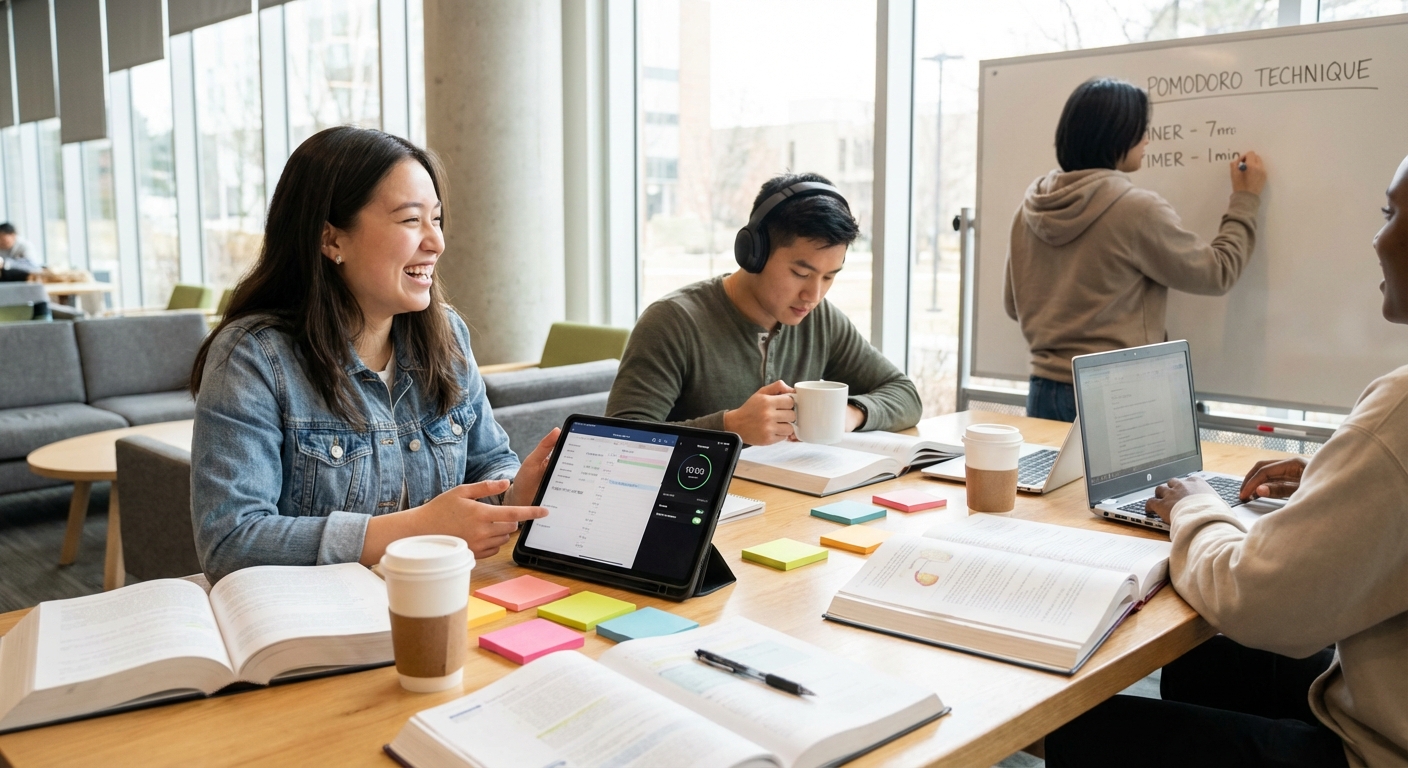
You know that feeling when you have three assignments due tomorrow and you’ve somehow watched every TikTok on your feed instead? Yeah, we’ve all been there. Procrastination isn’t about being lazy. It’s about your brain wanting instant rewards over future benefits. But here’s the thing: you can work with your brain instead of against it.
These study hacks that actually work are designed for real students who procrastinate. They include time-blocking methods, environment changes, and reward systems that trick your brain into focusing. You’ll learn practical techniques like the Pomodoro method, body doubling, and strategic break-taking that make studying feel less overwhelming. Each hack is backed by student experience and can be implemented immediately without special tools or apps.
Time blocking beats vague study plans every time
Your brain hates vague goals like “study biology today.” It needs specific instructions.
Time blocking works because it removes decision fatigue. You’re not constantly asking yourself “what should I do next?” The schedule already decided for you.
Here’s how to do it right:
- Open your calendar app or grab a piece of paper.
- Write down every commitment you have this week (classes, work, meals, sleep).
- Look at the empty blocks left over.
- Assign specific subjects to specific blocks (not just “study time”).
- Set a timer when each block starts.
- Stop when the timer ends, even if you’re in the middle of something.
That last part sounds weird, but it’s crucial. When you stop mid-task, your brain keeps thinking about it. This is called the Zeigarnik effect. You’ll actually want to come back to finish it.
Students who time-block report finishing assignments 40% faster than those who study “whenever they feel like it.” That’s because you’re not wasting mental energy deciding what to do next.
The Pomodoro technique makes long study sessions manageable
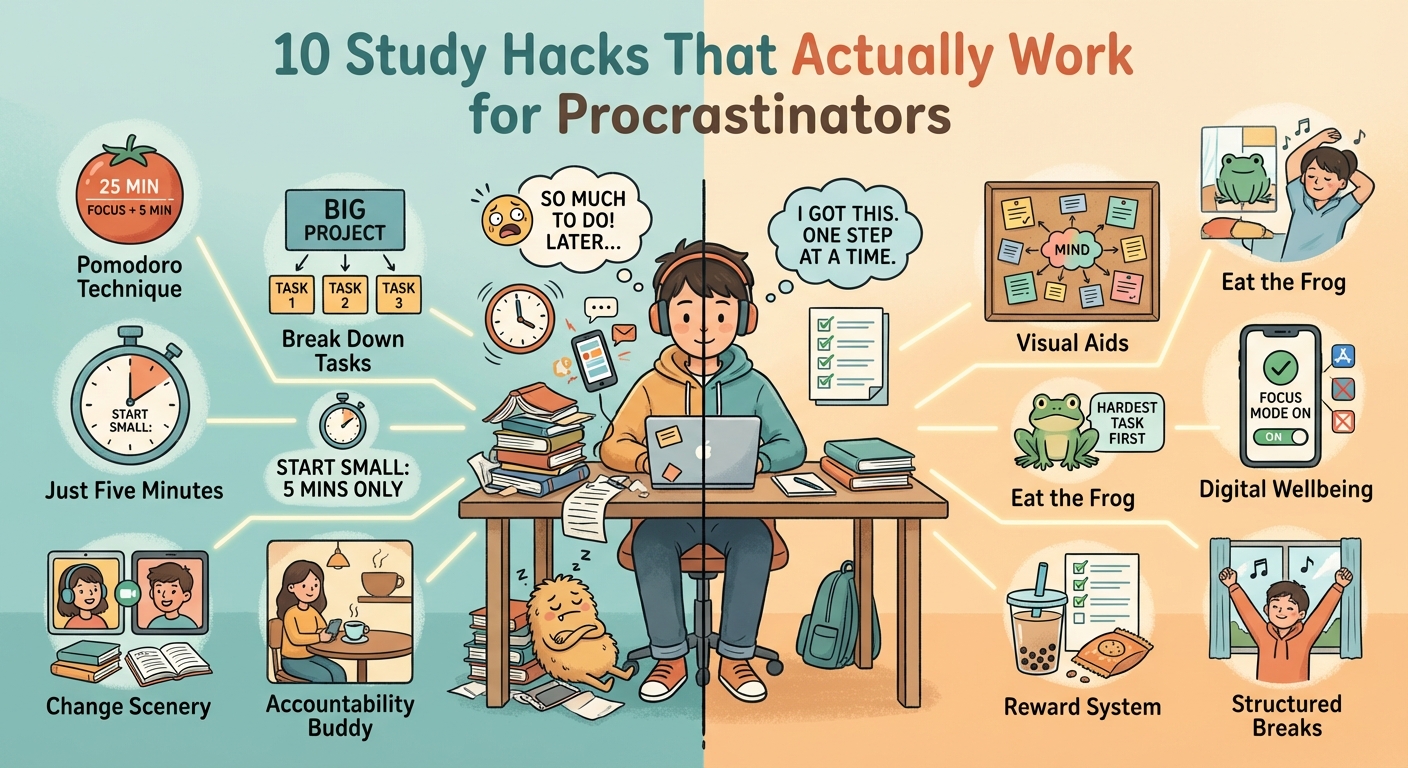
Sitting down for a four-hour study marathon sounds terrible. Your brain agrees.
The Pomodoro technique breaks work into 25-minute chunks with 5-minute breaks. After four rounds, you take a longer 15-30 minute break.
Why 25 minutes? Research shows that’s about how long most people can maintain deep focus before their attention starts wandering. You’re working with your natural attention span, not fighting it.
Here’s the basic setup:
- Set a timer for 25 minutes
- Work on one task only
- When the timer rings, take a 5-minute break
- Do something completely different during breaks (walk around, grab water, stretch)
- After four rounds, take a longer break
The magic happens because you can convince yourself to do anything for just 25 minutes. Even if you really don’t want to start that essay, you can handle 25 minutes. Then you’re already started, which is the hardest part.
One student shared that she went from failing two classes to making the dean’s list after switching to Pomodoro. She said the breaks kept her from burning out, and the timer created urgency that pushed her to focus.
Body doubling turns studying into a social activity
Body doubling means working alongside someone else, even if you’re doing different tasks.
This works incredibly well for procrastinators because having another person present creates gentle accountability. You’re less likely to scroll Instagram when someone’s sitting across from you grinding through their own work.
You don’t need to talk or work on the same subject. You just need to be in the same space, both working.
Ways to body double:
- Meet a friend at a cafe or library
- Join a study Discord server with video chat
- Use apps like Focusmate that pair you with random study partners
- Sit in a common area instead of your room
- Study at 5 new cafe openings in Singapore that are already blowing up on Instagram for a change of scenery
The presence of another person activates your social brain, which is way more powerful than your discipline. You naturally mirror the behavior of people around you. If they’re focused, you’ll focus too.
Change your environment before you change your habits
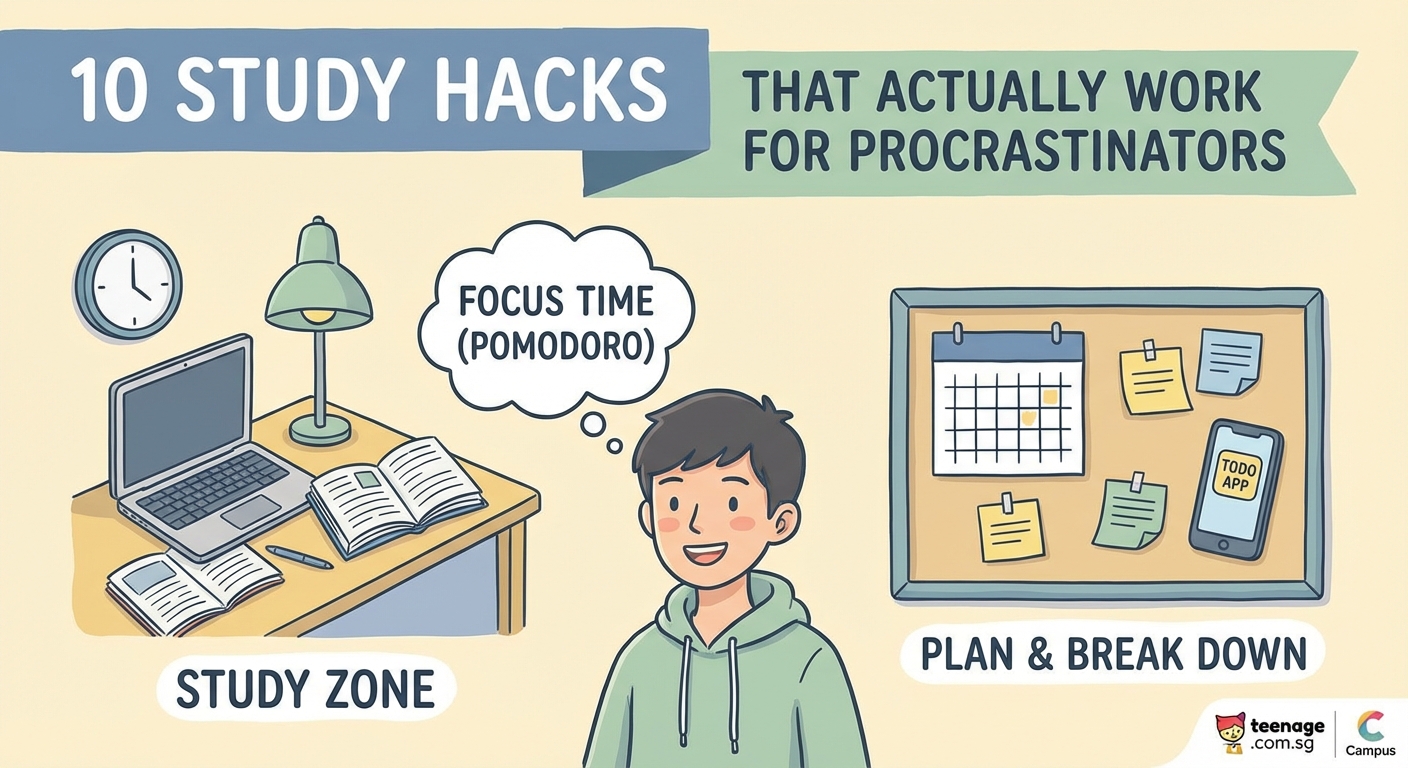
Your bedroom is for sleeping and scrolling. Your brain knows this. Trying to study there is like trying to sleep at a concert.
Environment shapes behavior more than willpower does. If you always procrastinate in your room, your brain has linked that space with procrastination.
Create a dedicated study space that your brain associates only with work. This could be:
- A specific corner of the library
- A particular cafe table
- Your kitchen table (but only during study hours)
- A friend’s apartment
- Even a different chair in your room
The key is consistency. Always study in that spot. Never scroll social media there. Your brain will start entering “work mode” automatically when you sit down.
One trick that helps: change something physical about yourself when you study. Put on a specific hat, wear blue light glasses, or light a particular candle. These become triggers that tell your brain it’s time to focus.
Strategic procrastination is actually a study hack
This sounds backwards, but hear me out.
You’re going to procrastinate anyway. So procrastinate on purpose, strategically.
Give yourself permission to procrastinate for exactly 15 minutes before starting. Set a timer. Scroll TikTok, watch YouTube, do whatever. But when that timer goes off, you start working.
This removes the guilt and rebellion that makes procrastination worse. You’re not “giving in” to procrastination. You planned it.
Here’s what happens: your brain stops fighting you because it got what it wanted. The urge to procrastinate decreases because it’s no longer forbidden. And you’ve set a clear boundary between fun time and work time.
Another version: procrastinate on hard tasks by doing easier tasks. Need to write an essay but can’t start? Organize your notes instead. Make flashcards. Highlight your textbook. You’re still being productive, and often the momentum carries you into the harder task.
“I used to feel guilty every time I procrastinated, which made me procrastinate more to avoid the guilt. When I started scheduling procrastination time, everything changed. I actually procrastinate less now because I’m not constantly fighting myself.” – College junior, psychology major
The two-minute rule gets you past the starting line
Starting is harder than continuing. That’s why you can scroll for two hours but can’t start a 20-minute assignment.
The two-minute rule says: if a task takes less than two minutes, do it immediately. But for studying, we twist it: commit to just two minutes of work.
Tell yourself you only have to study for two minutes. Not 20, not two hours. Just two.
Here’s what happens: you start. And starting is 80% of the battle. Once you’re two minutes in, you’ll usually keep going because stopping feels more disruptive than continuing.
Your brain’s resistance is highest before you start. Once you’re moving, inertia works in your favor.
Apply this to any study task:
- Open your textbook (that’s it, just open it)
- Write one sentence of your essay
- Do one practice problem
- Read one paragraph
- Review one flashcard
Each of these takes less than two minutes. But they get you started, and that’s the hardest part.
Active recall beats passive reading by a mile
Reading your notes over and over feels like studying. It’s not.
Your brain is lazy. When you read something, it thinks “yeah, that looks familiar” and assumes you know it. But recognition isn’t the same as recall.
Active recall means forcing your brain to retrieve information without looking at your notes. This is hard. It feels bad. That’s how you know it’s working.
| Study Method | Feels Like | Actually Effective |
|---|---|---|
| Reading notes | Easy, comfortable | Low effectiveness |
| Highlighting textbooks | Productive, busy | Minimal retention |
| Rewriting notes | Time-consuming | Slightly better |
| Active recall | Difficult, frustrating | Highest retention |
| Teaching someone else | Engaging, social | Very effective |
Ways to practice active recall:
- Close your notes and write down everything you remember
- Use flashcards (but actually test yourself, don’t just flip through)
- Explain concepts out loud like you’re teaching a class
- Do practice problems without checking your notes first
- Quiz yourself before looking at answers
Research shows students who use active recall score 50% higher on exams than students who just reread material. The struggle is the point. If it feels easy, you’re not learning.
Reward systems work better than punishment
Threatening yourself doesn’t work. “If I don’t finish this essay, I’m a failure” just makes you feel bad and procrastinate more.
Rewards work because they give your brain something to look forward to. Remember, procrastination happens because your brain wants immediate rewards. So give it some.
Set up a reward system:
- Finish one Pomodoro session, watch one YouTube video
- Complete an assignment, buy your favorite snack
- Study for two hours, play video games for 30 minutes
- Ace a practice test, hang out with friends
The reward has to come after the work, not before. And it has to be immediate. “I’ll reward myself at the end of the semester” doesn’t work because that’s too far away.
Make the rewards proportional to the effort. Don’t reward yourself with a three-hour Netflix binge for doing 20 minutes of work. Your brain will learn to game the system.
Some students use apps that lock their phone until they complete study goals. Others literally hide snacks around their study space and “unlock” them after finishing sections. Whatever works for your brain.
Study during your peak energy hours
You’re not equally productive at all times of day. Your brain has peak hours.
Some people are morning people. Some are night owls. Most of us are somewhere in between. Fighting your natural rhythm makes studying way harder than it needs to be.
Track your energy for a week. Notice when you feel most alert and focused. That’s when you should tackle your hardest subjects.
Schedule your study sessions around your energy:
- High energy hours: difficult subjects, new material, complex problems
- Medium energy hours: review, practice problems, organizing notes
- Low energy hours: easy tasks, watching lecture videos, reading
If you’re a morning person, don’t waste 8 AM scrolling in bed. That’s prime brain time. Study then. Save the mindless tasks for when you’re tired anyway.
If you’re a night owl, stop trying to study at 7 AM. You’re just torturing yourself. Study at 10 PM when your brain actually works.
This ties into building a morning routine that actually sticks in college if you’re trying to shift your schedule.
Break tasks into stupidly small steps
“Write essay” is too big. Your brain sees that and panics.
Break it down until each step feels almost too easy:
- Open Google Docs
- Type your name and the date
- Write the essay title
- Write one sentence for the introduction
- Write another sentence
- Find one source
- Read the first page of that source
- Write one sentence about what you read
See how each step takes less than five minutes? That’s the goal.
Big tasks trigger procrastination because they feel overwhelming. Small tasks don’t. Your brain can handle “open Google Docs.” Once you’re there, you might as well type your name. Once you’ve done that, you might as well keep going.
This is especially helpful for group projects, which nobody tells you how to handle until you’re already struggling.
Mix subjects to boost retention
Studying one subject for five hours straight feels efficient. It’s not.
Your brain gets bored. After about 90 minutes on the same topic, your retention drops significantly. You’re putting in time but not getting results.
Interleaving means mixing different subjects or topics in one study session. Study math for 45 minutes, switch to history for 45 minutes, then back to math.
This feels less efficient because you’re constantly switching gears. But research shows it improves long-term retention by up to 43%. The mental effort of switching contexts actually strengthens your memory.
A sample interleaved study session:
- 8:00 AM: Math problems (Pomodoro 1 & 2)
- 9:00 AM: Biology reading (Pomodoro 3 & 4)
- 10:00 AM: Long break
- 10:30 AM: History essay (Pomodoro 5 & 6)
- 11:30 AM: Back to math (Pomodoro 7 & 8)
Notice how you return to subjects after a break. This spacing effect helps move information from short-term to long-term memory.
The key is mixing similar but distinct topics. Don’t switch between calculus and algebra (too similar). Switch between math and English (different enough to engage different brain areas).
Managing multiple subjects while balancing everything else is covered in the ultimate guide to balancing school, social life, and self-care.
Making study hacks stick in real life
These techniques work, but only if you actually use them.
Start with one hack. Just one. Try it for a week before adding another. Most students fail because they try to overhaul their entire study routine at once. That’s overwhelming, and you’ll quit.
Pick the hack that sounds easiest or most appealing. Maybe it’s the two-minute rule. Maybe it’s body doubling. Start there. Get comfortable with it. Then add another.
Remember, you’re training your brain to work differently. That takes time. Be patient with yourself. You’re not going to transform from a chronic procrastinator to a productivity machine overnight.
But you can study for 25 minutes today. You can break one assignment into smaller steps. You can try studying at a cafe instead of your room.
Small changes compound. Each study hack you implement makes the next one easier. Your brain starts learning that studying doesn’t have to be torture. It can actually be manageable, even satisfying.
The goal isn’t perfection. It’s progress. Even using these hacks 60% of the time will dramatically improve your grades and reduce your stress. That’s what actually matters.














Post Comment