15 Movie Plot Twists That Completely Broke the Internet

You know that feeling when a movie ending hits you so hard you just sit there in silence, staring at the credits? That moment when everything you thought you knew gets flipped upside down, and you immediately want to rewatch the entire film to catch all the clues you missed? These are the movie plot twists that didn’t just surprise audiences. They sparked thousands of Reddit threads, broke Twitter, and became the kind of spoilers people desperately tried to avoid for months.
The best movie plot twists work because they’re both surprising and inevitable. Films like The Sixth Sense, Fight Club, and Parasite delivered endings that shocked viewers while making perfect sense in retrospect. These twists became cultural moments, generating millions of online discussions and changing how we think about storytelling. Understanding what makes these reveals so effective can deepen your appreciation for cinema and help you spot the clues filmmakers plant throughout their work.
What Makes a Plot Twist Actually Work
Not every surprise ending deserves the hype.
The truly great movie plot twists follow a specific formula. They recontextualize everything you’ve watched without feeling cheap or manipulative. The clues were there all along, but the filmmaker distracted you just enough to keep you from seeing the full picture.
A weak twist relies on withholding information or straight-up lying to the audience. A strong one plays fair while still managing to shock you.
Think about how you felt watching these films for the first time. The best twists make you want to immediately watch the movie again, this time looking for all the hints you missed. That rewatchability factor is what separates a gimmick from a genuine masterpiece of storytelling.
The Twists That Changed Cinema Forever
The Sixth Sense (1999)
Bruce Willis was dead the whole time.
Even people who haven’t seen the film know this twist. M. Night Shyamalan crafted one of the most carefully constructed mysteries in modern cinema, planting subtle visual cues throughout that only make sense on a second viewing.
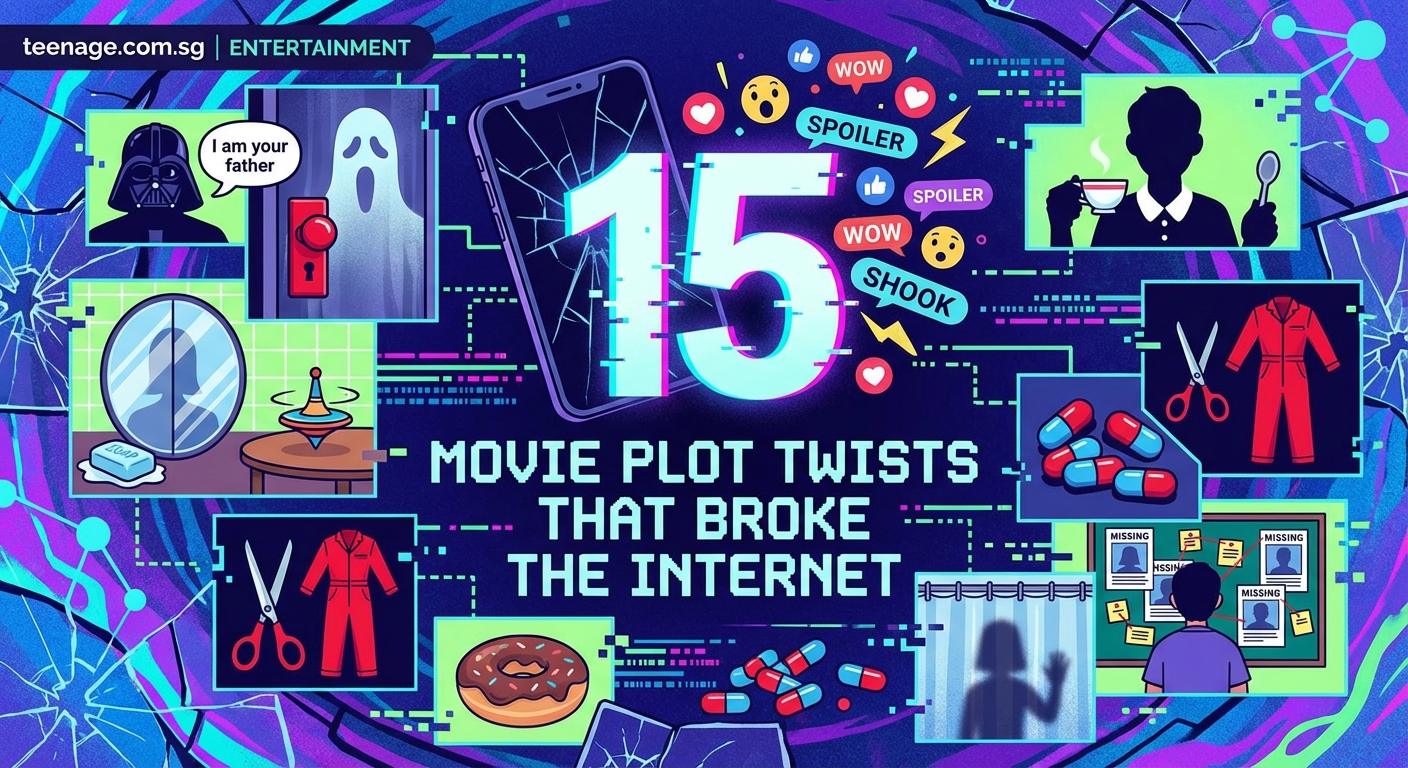
The red doorknob. The temperature drops. The fact that Bruce Willis never directly interacts with anyone except the kid.
When the reveal happens, it doesn’t feel like a cheat. It feels like the only answer that makes sense.
Fight Club (1999)
Tyler Durden doesn’t exist.
The narrator and Tyler are the same person, and once you know that, every scene takes on new meaning. David Fincher left breadcrumbs everywhere. The single-frame flashes of Tyler before he officially appears. The moments when other characters only acknowledge one of them.
This twist turned a movie about toxic masculinity into a psychological breakdown caught on film.
The Usual Suspects (1995)
Verbal Kint is Keyser Söze.
Kevin Spacey’s limping, seemingly harmless character spins an elaborate story to the police, and we watch as the detective realizes too late that everything was a lie. The final sequence, where Verbal’s limp disappears and the camera reveals how he fabricated details from objects in the office, remains one of the most satisfying twist endings ever filmed.
Parasite (2019)
The entire basement reveal.
This isn’t just one twist. It’s a cascade of reveals that completely changes the film’s trajectory. Just when you think you understand the class commentary Bong Joon-ho is making, he introduces another family living in the hidden basement, and suddenly the whole story becomes infinitely more complex and disturbing.
The twist works because it’s not about shocking you for shock’s sake. It deepens the themes and raises the stakes in ways you didn’t see coming.
How Filmmakers Plant Clues Without Giving It Away
| Technique | How It Works | Example |
|---|---|---|
| Visual misdirection | Draw attention to one detail while hiding another in plain sight | The Sixth Sense’s red objects marking the supernatural |
| Unreliable narrator | Let the audience see through compromised eyes | Shutter Island’s entire perspective problem |
| Selective editing | Show only what supports the false narrative | Fight Club’s careful framing in shared scenes |
| Dialogue ambiguity | Lines that mean one thing initially, another after the reveal | The Prestige’s “Are you watching closely?” |
Directors use these tools to play fair while still fooling you.
The best twists reward careful viewers without punishing casual ones. You should be able to enjoy the film either way, but a rewatch should reveal the architecture underneath.
Modern Twists That Broke the Internet
Get Out (2017)
The Armitage family doesn’t want to kill Black people. They want to become them.
Jordan Peele’s directorial debut delivered social commentary wrapped in horror, and the twist about the “sunken place” and consciousness transfer hit audiences like a freight train. The film sparked countless think pieces and became required viewing for understanding modern racial dynamics in cinema.
Knives Out (2019)
Rian Johnson pulled off something remarkable. He showed you the murder in the first act, let you think you knew what happened, then systematically revealed three more layers underneath that initial understanding.
The twist isn’t about who did it. It’s about why we assumed we knew who did it.
Arrival (2016)
Time isn’t linear, and Amy Adams’ character isn’t having flashbacks. She’s having flash-forwards. The “memories” of her daughter aren’t memories at all, but visions of a future that hasn’t happened yet.
This twist transforms a first-contact alien film into a meditation on choice, free will, and whether you’d live your life the same way if you knew all the pain coming.
Oldboy (2003)
The relationship reveal in this Korean thriller is so disturbing that most people refuse to rewatch it. Park Chan-wook crafted a revenge story that punishes both the protagonist and the audience for not asking the right questions earlier.
Content warning aside, it’s a masterclass in how to make a twist feel inevitable in retrospect.
The Anatomy of a Perfect Reveal
Building to a great twist requires specific storytelling steps.
- Establish the rules of your world clearly
- Plant genuine clues that can be spotted on rewatch
- Create misdirection that feels organic, not forced
- Make the reveal change everything while breaking nothing
- Ensure the twist deepens themes rather than just shocking
The worst twists ignore their own setup. The best ones make you realize the setup was telling you the truth all along, just in a language you didn’t yet understand.
“A good plot twist should make you feel stupid for not seeing it coming, but also make you feel smart when you go back and spot all the hints.” This principle, followed by the best thriller directors, separates gimmicks from genuine storytelling craft.
Why Some Twists Age Better Than Others
The Sixth Sense still works decades later because it’s built on character and emotion, not just the surprise.
Compare that to films where the twist is the only thing the movie has going for it. Once you know the secret, there’s no reason to return. The reveal becomes the entire point, and the film collapses without it.
The enduring classics use their twists to illuminate character or theme. The forgettable ones use them as a replacement for actual storytelling.
What Reddit Gets Right About Analyzing Twists
Film communities online have become incredibly sophisticated at breaking down what works and what doesn’t. They’ve identified patterns across decades of cinema.
The “it was all a dream” twist almost never satisfies because it invalidates everything that came before. The “unreliable narrator” twist works when the narrator’s unreliability tells us something meaningful about them.
Audiences have gotten smarter. They’ve seen enough twists to spot the patterns. That’s why modern filmmakers have to work twice as hard to genuinely surprise viewers.
Twists That Sparked the Most Online Debate
Some reveals don’t just surprise you. They make you argue with strangers on the internet for hours.
- Inception’s ending: Is the top still spinning? Does it matter?
- Shutter Island: Was he really insane, or was the hospital gaslighting him?
- The Prestige: Which sacrifice was more meaningful?
- Interstellar: Does the bookshelf scene work scientifically?
These debates keep films alive in popular culture long after their theatrical runs. Similar to how why everyone’s talking about the latest k-drama that just dropped on netflix examines what makes certain shows conversation starters, these movie twists become cultural touchstones that define entire years of cinema.
Common Mistakes That Ruin Otherwise Good Twists
Even talented filmmakers mess this up sometimes.
The unearned reveal: Introducing crucial information in the final five minutes that was never hinted at earlier. This feels like cheating because it is.
The obvious twist: When every viewer sees it coming from scene one, playing it straight doesn’t create surprise. It creates frustration that the characters are so far behind the audience.
The meaningless shock: A twist that exists purely for surprise value without connecting to themes or character arcs. It’s empty calories.
The logic-breaking reveal: When the twist makes previous scenes impossible or nonsensical, you’ve lost your audience’s trust.
What Film Students Can Learn From These Moments
Studying great movie plot twists teaches you about structure, misdirection, and thematic coherence.
Watch each film twice. Once for the experience, once for the technique. Notice where your attention was directed and what was happening in the background. See how dialogue takes on double meanings. Observe how visual motifs prepare you for revelations you don’t consciously register.
The best film education comes from deconstructing what works. These twists work because they respect the audience’s intelligence while still managing to outsmart them.
- Pay attention to repeated visual elements
- Notice when characters avoid direct questions
- Track who interacts with whom
- Question assumptions the film wants you to make
- Look for information given through environment rather than dialogue
The Future of Plot Twists in Streaming Era
Spoiler culture has changed how twists function.
In the pre-internet age, a film could build word-of-mouth for weeks without revealing its secrets. Now, spoilers spread within hours of a film’s release. Directors have to account for this new reality.
Some filmmakers respond by making the twist less important than the journey. Others create multiple layers of reveals so that even spoiled viewers still have surprises waiting. A few have given up on traditional twists entirely, finding other ways to create memorable moments.
The challenge for modern cinema is creating experiences that work whether you know the twist or not. Just like what streaming service is actually worth your money in 2024 helps navigate an overwhelming landscape, understanding how twists function in the age of instant information helps you appreciate the craft even more.
Why We Keep Coming Back to These Films
Great movie plot twists tap into something fundamental about storytelling.
Humans love the feeling of pieces clicking into place. We love realizing we had all the information we needed but assembled it wrong. We love the moment when chaos resolves into order, when the random becomes intentional.
These films give us that satisfaction while also making us feel something real. The twist in The Sixth Sense works because it’s about grief and acceptance. Fight Club’s reveal illuminates mental illness and identity. Parasite’s cascade of twists exposes class warfare.
The surprise is the hook. The emotion is what keeps you thinking about it years later.
Films That Almost Pulled Off the Perfect Twist
Not every attempt succeeds completely, but the effort reveals something interesting about the form.
The Village had all the pieces in place, but the tonal shift felt too jarring for many viewers. Now You See Me delivered a fun reveal that doesn’t quite hold up under scrutiny. The Others crafted a beautiful twist that works emotionally even if you see it coming.
These near-misses teach us as much as the successes. They show where the line is between clever and too clever, between surprising and confusing, between meaningful and gimmicky.
How These Twists Changed What Audiences Expect
After The Sixth Sense, every thriller tried to have a surprise ending.
This led to a few years where audiences walked into every film actively looking for the twist, which made genuine surprises harder to pull off. Filmmakers had to get more creative or abandon the technique entirely.
The best modern directors use this heightened awareness against audiences. They plant fake clues that lead nowhere. They set up what looks like an obvious twist, then go in a completely different direction. They play with your expectations of being played with.
It’s an arms race between filmmakers and increasingly sophisticated viewers.
Why These Moments Still Matter
In an era of spoilers and endless content, a truly shocking twist remains one of cinema’s most powerful tools.
These fifteen films didn’t just surprise audiences. They created shared cultural moments where millions of people experienced the same revelation, then immediately wanted to talk about it with everyone they knew. That communal experience of discovery and discussion is what separates cinema from simply watching content.
The next time you settle in to watch a thriller or mystery, pay attention to how the filmmaker is guiding your attention. Notice what questions they want you to ask and which ones they hope you’ll ignore until the perfect moment. The craft of misdirection is one of the most sophisticated skills in filmmaking, and these movies represent masters of the form working at their peak.
Whether you’re revisiting these classics or discovering them for the first time, the best movie plot twists remind us why we fell in love with cinema in the first place. That moment of genuine surprise, of having the rug pulled out from under you in the best possible way, never gets old.














Post Comment